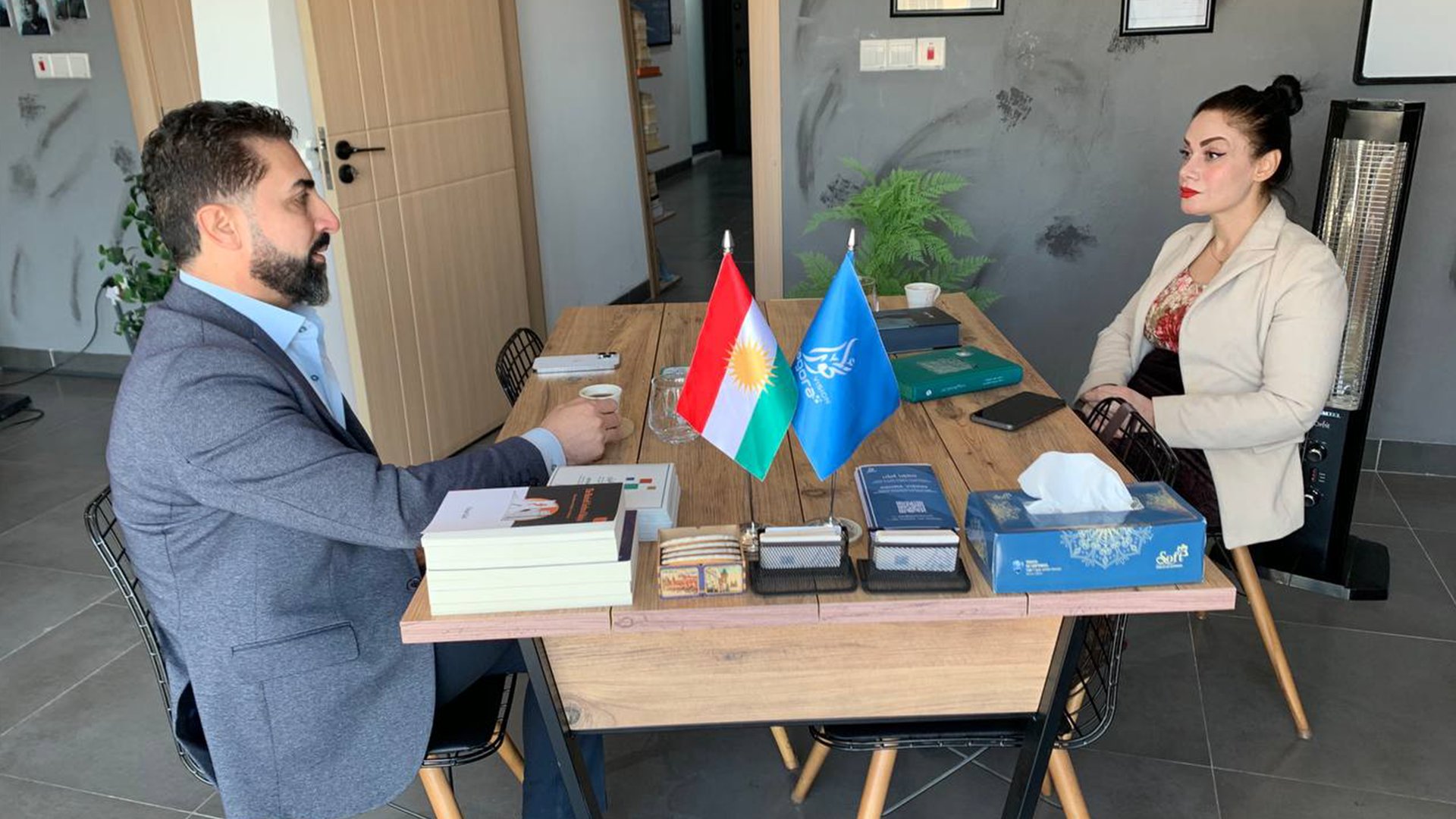
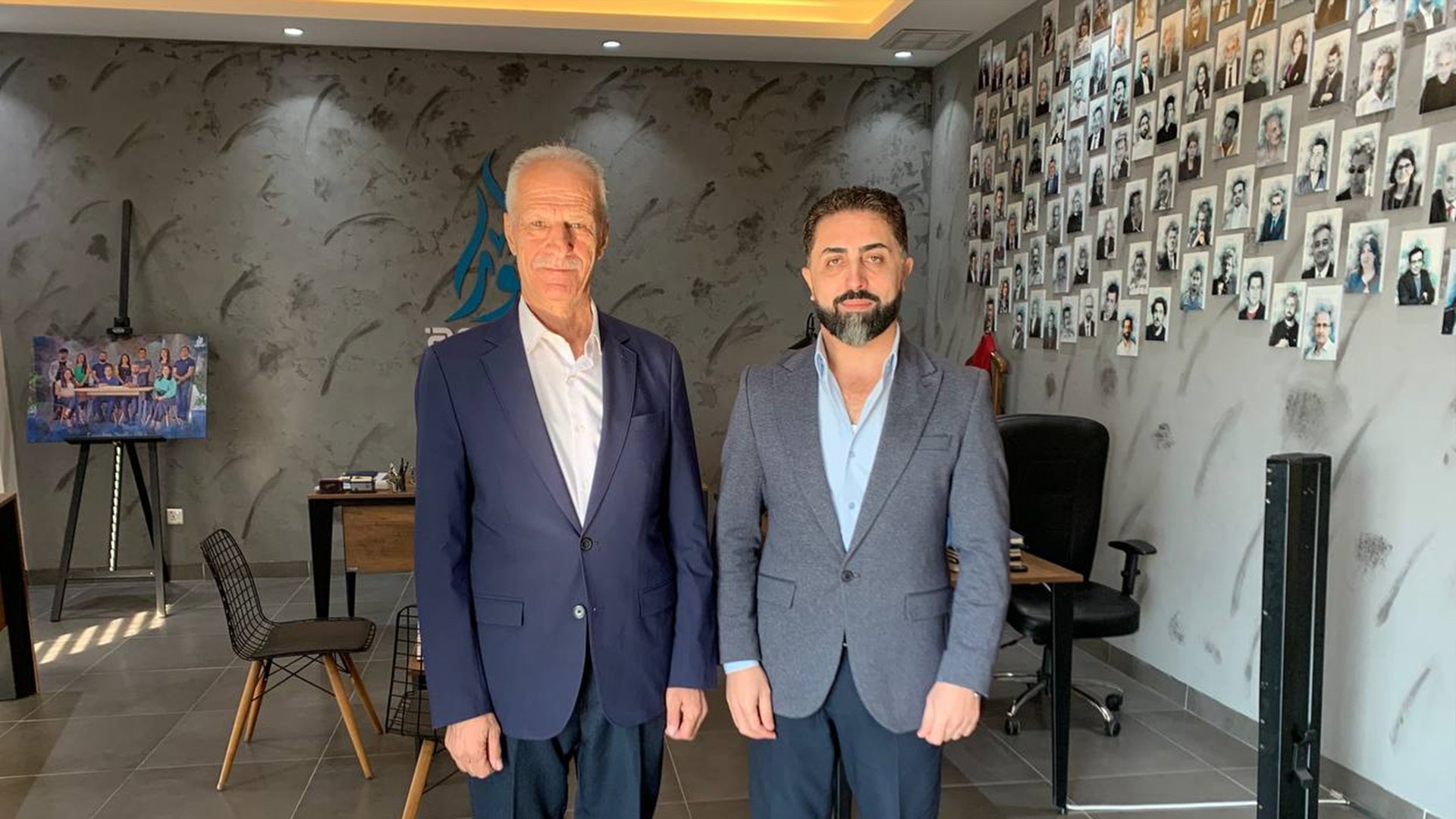
Dr. Hemin Latif, Founder of Agora Vision, in conversation with Eurasia Today
158 | 2026-10-29
The Kurdish Word
October 11, 2026
Kurdish literature is barely read outside Kurdistan, not because it has nothing to say, but because it is locked inside its own language. Dr. Hemin Latif, an assistant professor at the American University of Iraq, Sulaimani (AUIS) and the founder of Agora Vision, set out to change that. His project is digitizing the region’s rich literary heritage, producing audiobooks in all the Kurdish dialects, and translating prose into English. In an interview with Eurasia Today, Dr. Latif spoke about how Agora Vision fights piracy, why it is time for the West to stop seeing Kurds only through the lens of geopolitical news, and which books are the best place to begin discovering the culture of Kurdistan.
-- Agora Vision began as a tech startup, but in essence it is a cultural mission. How do you personally define the line between business and mission? Which comes first for you?
Hemin: For me, the mission comes first. My doctorate is in interaction design and robotics, and for years I had the tools without the cause. Technology, in the end, is only a tool; it needs a context and a purpose. Kurdish literature became that purpose. The business is the vehicle that moves the mission forward, and I respect what that vehicle needs. Businesses are powerful institutions that can bring resources together to create change, and without resources, including money, no institution survives long enough to have an impact. So, the line, for me, is between acknowledging the need for finance and working for financial gain.
-- The name “Agora” refers to the ancient Greek agora – a public square and a place for meeting and exchanging ideas. How do you see this “square” today: what does it bring together – people, texts, voices? And what is most important within it?
Hemin: The Greek agora, in essence, was a place for bringing people together. The Agora of Agora Vision does the same, but as a digital platform, and its power is not limited to scale or lower production costs. Kurds are divided in many ways: politically, historically, geographically, religiously, and economically. A Kurd in Iraq, a Kurd in Iran, and a Kurd in Europe live in very different worlds. A platform that crosses these borders and brings Kurds from every part together is what the Agora of Agora Vision is about. What matters most within it are the writers, many of whom have never been read outside their own city.
-- You launched Agora Deng – the first app for Kurdish audiobooks. How did the selection process for the first hundred books go? Did you have an internal manifesto about what should be recorded first and what could wait?
Hemin: There are some general rules of thumb for which books are suitable for audiobook production. Books that are too technical, books heavy in graphics and visuals, and books with poor print quality are not. This is true for most audiobook production around the world. But our challenge was very different. Agora Vision went against a production and copyright culture that has long been the norm, at least in the Kurdistan Region of Iraq: a culture of reproducing literary work, in any form, without consulting the copyright owners. Individuals, groups, bookstores, and sometimes even formal institutions reproduce someone’s literary work without any copyright agreement. Agora Vision decided to correct this by signing contracts with the rightful copyright owners of every single literary work we touch. That was one of the main criteria we have been using to decide what we could work on and what we could not: can we find the copyright owners, get in touch with them, and have them agree to our contract? In fact, we have set aside many titles for one of these reasons: we could not locate the copyright owner, we could not reach them, or we could not get their approval for audiobook production. It cost us titles, but every book in our catalog has its author’s agreement behind it.
-- Kurdish literature exists in different dialects – Sorani, Kurmanji, and others. Agora Vision works with all of them. Do you encounter tension between dialects, and does technology help bridge them or make it harder?
Hemin: That is one distinctive feature of Agora Vision’s catalog: it is not only the largest exclusive catalog of Kurdish audiobooks; it is also diverse and comprehensive in its content. There is diversity of genres, diversity of narrator voices, and, most importantly, diversity of dialects, with titles from all the Kurdish dialects brought together. The difficulty is finding narrators for the different dialects, especially since we are based in an area where Sorani is dominant. Unfortunately, this is not something technology has helped with. We experimented with remote recordings, but we realized that our own studio setup and supervision are necessary to maintain the quality we strive for. So, the challenge continues. But it is part of the mission of Agora Vision, and we will keep bringing titles from all the dialects into our catalog.
-- Your project covers authors “from all four parts of Kurdistan.” How do you build relationships with authors from Iran, Turkey, Syria, and Iraq? Do they have common expectations of your platform, or are they different?
Hemin: Generally, the Kurdistan Region of Iraq is the most open and accessible region, and it attracts Kurds, including authors, from all other parts of Kurdistan. Beyond that, Agora Vision relies on two networks. The first is social media, where Agora Vision has had a strong presence long enough to earn real recognition. The second is the network of authors itself: authors we have contracts with continually bring new authors to us, make introductions, and widen the circle. Much of this no longer needs to happen in person; plans, contracts, and book materials all move online. As for expectations, I can speak best for the authors I know in the Kurdistan Region of Iraq. Most of them write alongside another job, because writing in Kurdish rarely pays, and many have never had a readership beyond their own region, sometimes beyond their own city. What they want from us is the chance to change that. I expect much of this is shared across all four parts of Kurdistan, but these are the authors I know best.
-- You describe Kurdistan’s challenges: underdeveloped financial systems, low digital literacy, lack of startup funding. Which of these barriers turned out to be the most difficult – more than you expected? And which was easier to overcome than you expected?
Hemin: The most difficult challenge was, and still is, the underdeveloped financial system. Setting up to receive digital payments probably takes an entrepreneur one or two business days in many countries around the world. It took us five months of trial and error, and even then, the result was not as seamless as we had hoped. That is why most of our subscribers are still in the Kurdish diaspora rather than in Iraq itself. It is also why our ebook channel, hosted on Google Play Books, still struggles to reach readers inside Iraq, where Google Play Books does not even appear in search and tells users it is not available in their country. What I expected to be a challenge but turned out to be easier was building and growing such a large network of authors who are willing and ready to be part of our platforms.
-- Your long-term goal is “to achieve global recognition for Kurdish literature at the level of film production and awards.” What concrete steps do you see on this path? Are there already examples that inspire you?
Hemin: I believe the Kurdish library is one of the finest in the world. It has not reached the world yet, because it is written and published in Kurdish. Many people assume a translation is only worth doing if a major global publisher adopts it. I disagree. I publish our English translations through Amazon KDP because it means no upfront cost, unlimited revisions, print on demand, and truly global distribution. I would rather a book be out in the world than wait for someone else to decide it deserves to be. That choice has a cost. Some authors have declined to work with me because I have no global publishing partner, and they doubted this approach could achieve much. I understand them. But once these books reach the right readers, they can be great ambassadors for who Kurds are and why the world should know them. Many great films began as books, some of them books translated into a more widely read language. My vision is to see a film inspired by one of our translations from Kurdish into English.
-- Agora Voice is aimed at an English-speaking audience. What do you think a Western reader or listener should feel when they first encounter a Kurdish text?
Hemin: The aim of making samples of the Kurdish library available to English-speaking readers and listeners is twofold. The first is to convey the style, the taste, the flavor, the approach, the techniques, and everything else that makes Kurdish writing what it is. The second is to share some insight into the history, the culture, the sorrow, and the perseverance of a nation that has endured all this without the world knowing about it. When a Western reader first encounters a Kurdish book, I want them to ask themselves: How have I not heard of this before? How have I missed it? I want them to feel they are finally hearing these stories from the people they belong to. And by the last page, I want them looking for the next one.
-- Which Kurdish work would you call the “soul of the region”? Not the most famous, not the most politically significant, but precisely the one in which you hear the voice of Kurdistan most purely.
Hemin: Among the books Agora Vision has translated into English so far, I would choose The Buried Circles of Babylon by Omar Said. An international team goes into the desert to find the remains of Amytis, a lost Babylonian queen. Their Kurdish translator, Bako, far from his mountains, watches the dig uncover something else: mass graves, laid out in patterns no one can explain. In a medium-length novel, Said holds the grandeur of Babylon and the Anfal genocide in the same ground. Every image in it shows part of Kurdistan, and each one opens onto something larger: legend, history, the world as it is now, and what the future could hold for Kurds.
-- Which book would you recommend to a reader who knows nothing about Kurdistan and wants to start with a single text? And which one to someone who already knows the history but wants to understand the culture more deeply?
Hemin: For a first-time reader, I would start with Sisyphus: The Boy with Two Hearts by Aram Kakay Falah. Of all our books, it is the one most about Kurdish life itself rather than trauma, tragedy, and genocide. It stays at the level of one city and a handful of people: the city’s bazaar, two girls who are friends, identical twin brothers who fall in love with the same woman, and a doctor who comes home from abroad. It is a modern retelling of the myth of Sisyphus, except that Malak, a quiet chess player whose heart is failing, carries a second heart made of platinum instead of a stone. For someone who already knows some of the history, I would suggest two books that go deeper in completely different ways. In Hersh Shekh Omar’s Five Watches, a young watch repairman who cares for his mute mother hears five cast-off watches confess the lives of their owners. In Abdulqader Saeed’s Sold into the Desert, young Kurdish women taken during the Anfal genocide are sold across borders, and a Jewish journalist who recognizes their grief as his own people’s resolves to carry their story home. Saeed wrote it after sitting with survivors of Anfal and recording what they told him.
-- You write poetry yourself and have published collections. Do you have a favorite poem or line of your own that you consider your personal formula?
Hemin: A very interesting question, and one I never thought I would be asked about my work. I do have a personal formula, but it is not a poem of my own. It is a line by the great poet Sherko Bekas: “I will never let this cry be washed out; I will never let this death be forgotten by life.” To answer your question directly, though, I have a poem titled “Agora Vision” that tries to capture the drive behind this mission. It lists the efforts and legacies of Kurdish singers, writers, and translators, and then it says: “Only I have yet to give some value to being a Kurd, being a human, and being alive.” Agora Vision is my attempt to answer that line.
-- You talk a lot about preservation. But preservation is always a choice: some things remain, some things go. What, in your opinion, can Kurdish literature afford to lose? And what must it never lose under any circumstances?
Hemin: As Kurds, we are very protective of everything we think belongs to us, including small details and nuances. What we can afford to lose, and what we must not, depends on who you ask. For me, speaking about translation, the answer is clear. Many people believe a translation must reproduce exactly what the author meant, word for word. That standard makes translation impossible even to begin, and some would rather lose a whole book than lose a few details. Literal translation never reads well anyway. We can afford to lose a precise, literal meaning here and there. What we must never lose are the author's main images, style, and techniques but also reach a balance that a non-Kurdish reader can read smoothly. The aim is never a novel that reads as though it were written in English. It is a novel that reads as though it were written in Kurdish, for the whole world to read.